
AI Didn’t Explode. It Infiltrated.
In 2023, AI didn’t arrive with fireworks, it revealed how long it had been shaping business behind the scenes.
Most leaders don’t realize that the dashboards they rely on, the insights they trust, and the tools they use daily are already AI-powered.
This post walks through how AI evolved over 70 years from academic theory to embedded intelligence in business, and what your next move should be.
Phase 1: Symbolic Logic and Academic Foundations
AI’s journey started in the 1950s with rule-based systems and symbolic reasoning.
- 1956: The term “Artificial Intelligence” is coined at the Dartmouth Conference.
- 1958: Frank Rosenblatt develops the Perceptron, the first neural network.
- 1980s: Expert systems rise, but face limitations and the first “AI winter.”
Source: MIT Press on Early AI
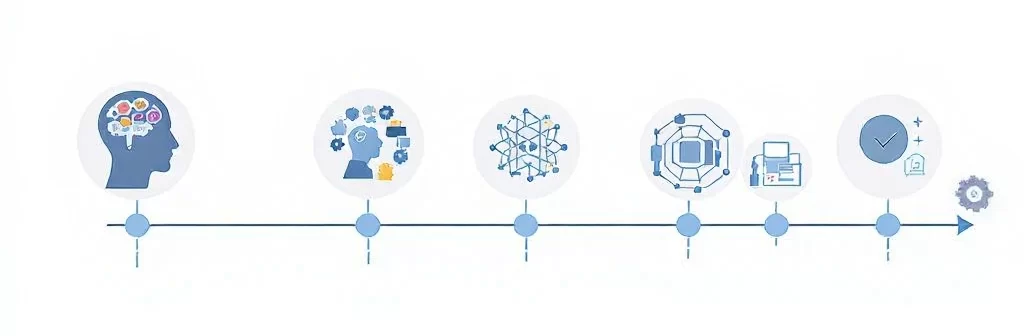
Phase 2: Infrastructure Revolution (2000–2015)
The conditions for modern AI were built on:
- Big Data: Explosive digital growth provided raw AI training material.
- Cloud Computing: AWS and Google made scalable computing accessible.
- GPU Acceleration: NVIDIA enabled massive AI compute via gaming tech.
Source: NVIDIA: Deep Learning & AI

Phase 3: AI Leaves the Lab (2016–2022)
AI quietly embedded itself into tools:
- Alexa/Siri: Conversational AI mainstreamed in homes.
- Netflix/Spotify: AI predicts preferences.
- Logistics: Forecasting and route planning.
This era marked real business adoption, without loud headlines.
Source: McKinsey Global AI Adoption Report 2022
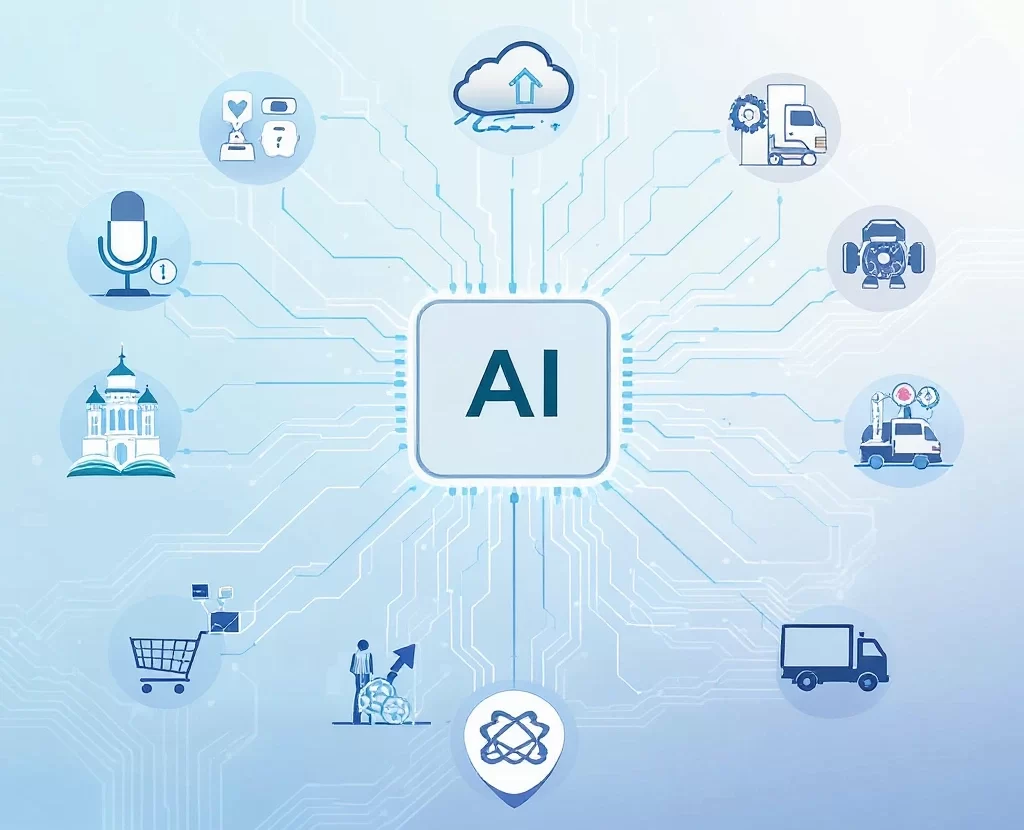
Phase 4: From Predictive to Autonomous (2025–2030)
AI is evolving rapidly across three frontiers:
- Real-Time Forecasting: AI will drive meeting decisions, predict shifts.
- Embedded Decision Support: AI will guide users in every tool.
- Autonomous Operations: Agents will execute deals, workflows.
Source: OpenAI GPT-4 | McKinsey GenAI Report

You’re Already Inside the AI Ecosystem
Business tools have evolved:
- 35% of dashboards now powered by AI.
- 67% of execs don’t realize their tools are AI-driven.
- 42% use AI but lack a clear strategy.
Source: BCG Future of AI Roadmap 2024 | Deloitte Tech Trends 2025

What Most AI Strategies Are Missing
Most companies treat AI as a feature, not a foundation. They focus on:
- Tool rollouts instead of strategy
- Headlines instead of ROI
- One-off projects instead of embedded intelligence
But real value comes from:
- Unified data
- Decision alignment
- Strategic forecasting
Ready to Lead, Not Lag?
Book a strategy session to map your next AI-powered quarter. Learn more at misterdata
Let’s build an AI roadmap that delivers clarity—not confusion.
0 Comments